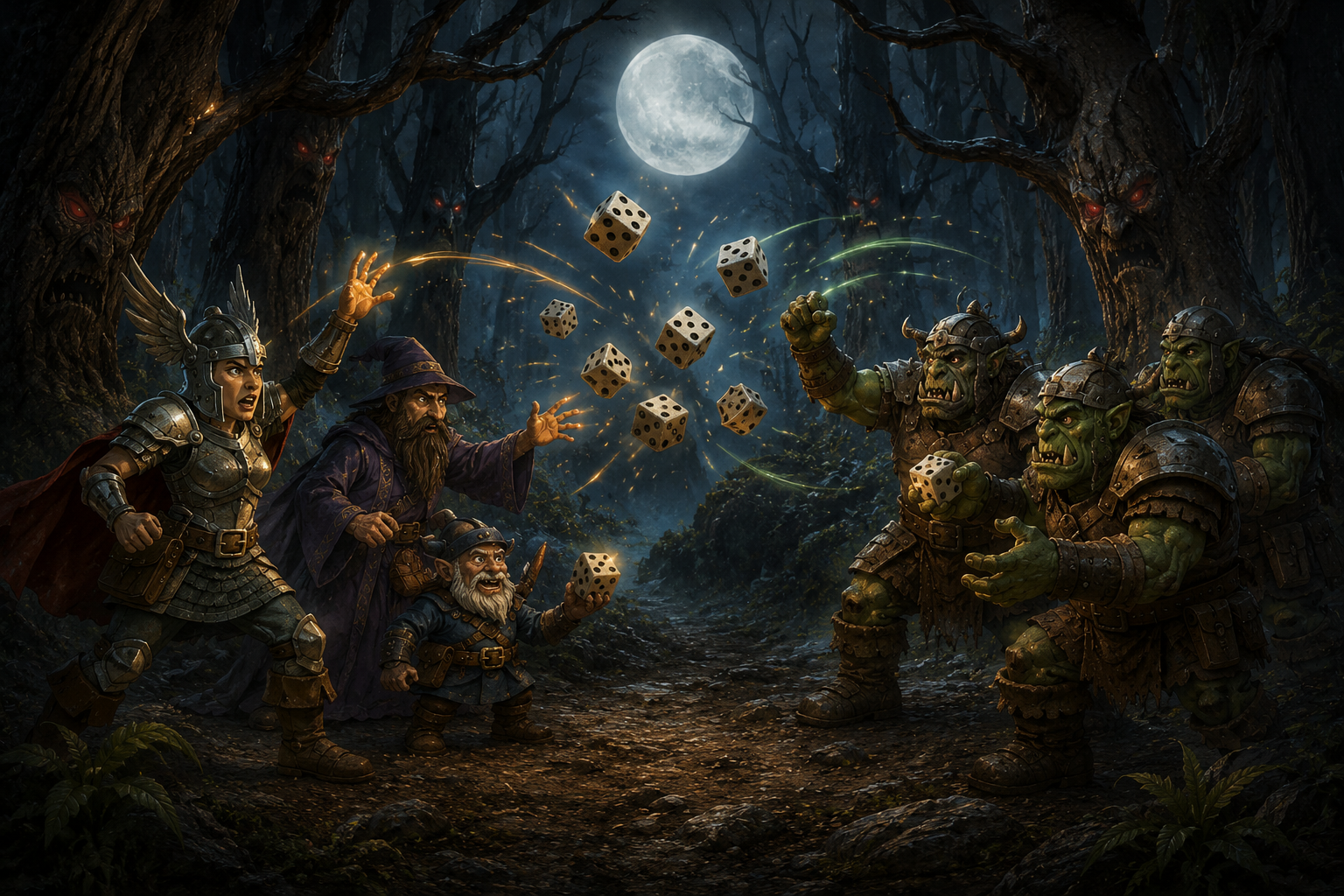
The rolling of the dice
When the outcome is uncertain, three six-sided dice (3d6) decide success — and how well or how badly it went.
When do you roll?
If the Game Master asks what your character does and there is no real risk, you simply do it: set up camp, tend the horses, visit a familiar tavern. No roll.
When skill, luck, or opposition matters, roll 3d6 against a target number from a statistic or skill (see below).
Success: roll equal to or below the target
Add your three dice together (after any modifiers the GM allows). You succeed if the total is less than or equal to your target number.
A higher target means a higher total still counts as success — so better scores are more reliable, not because the dice change, but because you can “afford” higher rolls.
Example: Target 12 and you roll 3+4+5 = 12 → success. Roll 3+5+6 = 14 → failure.
Statistics, skills, and the target number
Statistic rolls use the character’s current value for that stat (Strength, Agility, and so on).
Skill rolls use skill level + the linked statistic. A trained swordsman with high Agility therefore has a higher target than an untrained one.
Opposed rolls (skill vs skill): both sides roll. Each subtracts their roll from their own target; the higher margin wins. Rolling above your own target is a failure for that side.
How well did you do? (margin of success)
After you know pass or fail, the margin is:
margin = target − roll total
A positive margin is a success; a negative margin is a failure. The bigger the number, the more decisive the outcome. The GM uses the margin for narration and for some rule effects (Recovery points gained, shield bypass on hits, opposed-roll winners).
The eleven-step outcome scale
Every roll the app makes is graded on the same scale. The result you see (Hit, Skill, Perception, Recovery, anything) shows both the margin and a named outcome, so you don't have to mentally translate "I made it by 4" into "how good is that, exactly?".
| Margin | Outcome | Tier |
|---|---|---|
| Natural 3 | Legendary success | S6 (reserved) |
| +4 or more | Exceptional success | S5 |
| +3 | Great success | S4 |
| +2 | Solid success | S3 |
| +1 | Success | S2 |
| 0 | Marginal success | S1 |
| −1 | Near miss | F1 |
| −2 | Minor failure | F2 |
| −3 | Failure | F3 |
| −4 or worse | Severe failure | F4 |
| Natural 18 | Catastrophic failure | F5 (reserved) |
Natural 3 and natural 18 are reserved. They always count as the most extreme outcomes — regardless of how easy or hard the target was. A peasant can stitch a king's wound with a natural 3; a master surgeon can botch a bandage on a natural 18. The fiction the GM weaves around it should match.
Diminishing returns on high scores
Each +1 to your target is helpful, but not equally helpful across the whole range. Because 3d6 averages about 10½, improvements near the middle of the scale change your odds a lot; improvements when you are already excellent change them only a little.
Same dice, different targets
| Compare | Chance to succeed (3d6 ≤ target) | Difference |
|---|---|---|
| Target 10 vs 13 | 50.0% vs 80.6% | +30.6 points |
| Target 15 vs 18 | 92.1% vs 100% | +7.9 points |
At target 18 you always succeed on a straight 3d6 roll (the maximum roll is 18). In play, modifiers or harder situations can still make high targets meaningful.
Building the character: easy early, costly at the top
Improving a weak score is usually cheap in character points and gives a big jump at the table. Improving an already excellent score costs more points for a smaller gain in success rate — by design.
- Statistics treat 10 as the baseline. Moving up from low values is inexpensive; each step above 10 costs more than the last (11 costs 1 point from 10, then 2, then 3, and so on).
- Skills use a rising cost table: level 0→1 costs 1 point, but level 13→14 costs 14 points. High skill levels are a serious investment.
So a hero with legendary numbers paid for them — and still only buys a few extra percentage points of reliability compared to a solid professional.
3d6 reference: chance of rolling equal to or below
Use this table for “what are my odds on a straight roll with no modifiers?” Values are exact for fair dice (216 equally likely outcomes).
| Target (≤) | Success chance | Gain if target +1 |
|---|---|---|
| 3 | 0.5% | — |
| 4 | 1.9% | +1.4 |
| 5 | 4.6% | +2.8 |
| 6 | 9.3% | +4.6 |
| 7 | 16.2% | +6.9 |
| 8 | 25.9% | +9.7 |
| 9 | 37.5% | +11.6 |
| 10 | 50.0% | +12.5 |
| 11 | 62.5% | +12.5 |
| 12 | 72.2% | +9.7 |
| 13 | 80.6% | +8.3 |
| 14 | 87.5% | +6.9 |
| 15 | 92.1% | +4.6 |
| 16 | 94.9% | +2.8 |
| 17 | 96.3% | +1.4 |
| 18 | 100% | +3.7 |
“Gain if target +1” is how much the success chance rises when your target increases by exactly one (for example, 10→11 is +12.5 percentage points).
Related rules
- Stat & skill rolls — what each target is built from, plus opposed rolls.
- Combat — Initiative, Hit, Parry, Dodge, and how a round flows.
- Combat moves — every named manoeuvre and which roll it touches.
- Damage, armour & recovery — the damage tables, resilience, healing rates.
- Rules overview — the design philosophy and a map of these pages.
- At the table (Player Guide) — how the app runs these rolls during play.