Do's and don'ts for game masters
A short, opinionated checklist of things that tend to make games better — and things that tend to make them worse. None of this is law. Steal what works, ignore the rest.
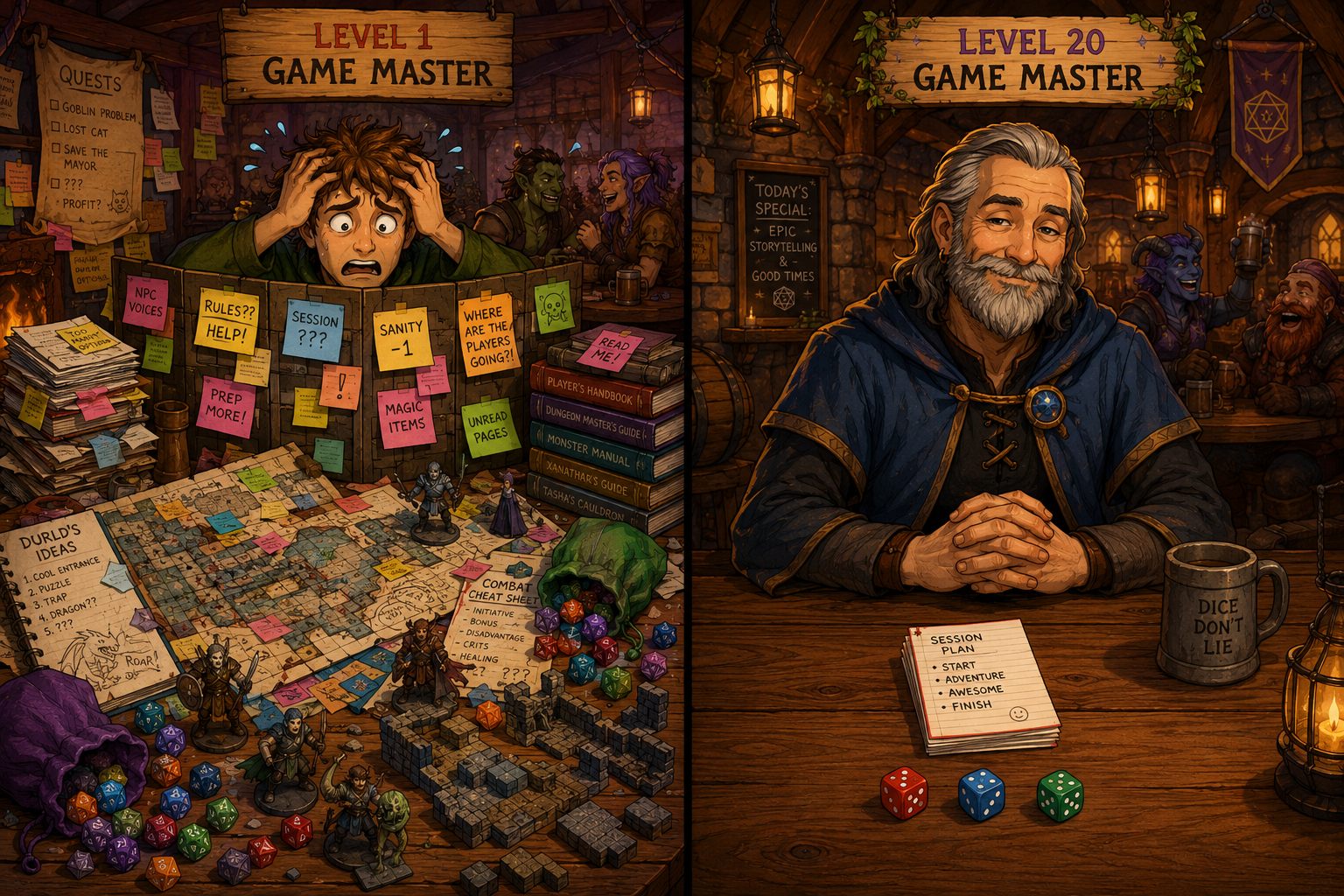
The big picture
Most of the advice on this page boils down to two ideas:
- Prep for opportunity, not for outcome. A good GM walks into a session with pieces — NPCs, locations, secrets, threats — that can fit anywhere. A tired GM walks in with a script the table will tear up by minute ten.
- You're a fan of the player characters. Their wins matter, their losses are interesting, and you're not their opponent. The world pushes back; you don't.
If you take only those two away from this page, the rest will fall into place on its own.
Preparation
Prep is for you — to feel ready, to keep the table moving, to have answers when the players go off the map. It is not the game itself.
- Do open Receive from players in the party editor before players arrive if you want live hand-offs — share the code once and Import each submission.
- Do prep atoms: a handful of NPCs with names and desires, a few locations with one or two striking details, a list of ten secrets the party might stumble onto. These work anywhere.
- Do write a strong opening — one sentence the party walks into that tells them the game has started. "You round the bend and a wagon is on fire." Better than "you arrive at the inn."
- Don't script scenes. Outlined ideas are gold; "and then the party must decide to do X" is fool's gold. Players don't read the script.
- Don't prep what the party can't reach. If two hours of work depends on them also deciding to climb the tower, that's two hours you spent for nothing. Save it for next session if it comes up; it usually will.
Pacing
A session has rhythm. You're the metronome.
- Do alternate intensity. Action then a quiet conversation. A loss then a small win. Hope then dread. Three combats in a row exhausts everyone — you most of all.
- Do cut hard. End a scene the moment its purpose is served. "You leave the inn at first light." Don't narrate the breakfast.
- Don't dwell on lookups. If you're flipping pages for more than thirty seconds, make a ruling, write it down, and move on. You can correct yourself later; you can't get back the table's attention.
- Don't let one player monopolise the spotlight on autopilot. Check in with the quiet ones — ask them what their character notices.
NPCs and the world
NPCs are the texture of the game. They don't need stat blocks; they need wants.
- Do start from the app's default pack. On a new campaign, leave Include default NPCs on and save — then trim what you won't use. Details: Include default NPCs.
- Do give each named NPC a one-line desire and a one-line tic. "Wants to clear her late father's debt; can't look you in the eye." That's enough to roleplay a whole evening.
- Do let the world react. Choices have downstream effects — if the party burns down a barn, by next session the village is whispering. That's how a world feels alive.
- Don't infodump through NPCs. If a scholar lectures the party for fifteen minutes, the scholar is bad and so is the scene. Distribute lore across short conversations, found documents, environmental details.
- Don't stat every NPC. A carpenter has hands and a hammer; a guard has a stick. You almost never need numbers for that. Save stat blocks for things the party will actually fight.
Players, not opponents
The GM-versus-party framing is the single most common trap. You control the universe; the players control four people. It is not a fair fight, and it's not meant to be one.
- Do say yes. If a player asks "is there a window?", the answer is yes unless there's a good reason it can't be. Creative input from the table is fuel.
- Do reward curiosity. If they poke at the painting on the wall, the painting has something. Maybe just a clue, maybe just flavour — never nothing.
- Don't punish creativity with a wall of "no". If the players propose a wild plan, find the version that's a roll, not a refusal. Players love being told "make it harder, but go ahead and try."
- Don't "win" against the party. If you build an encounter to kill them because the last one was easy, you're playing a different game from your table.
Combat and danger
Combat should feel risky, not arbitrary.
- Do telegraph danger. The dragon has burned villages already — the party heard the stories. The trap had warning runes the wizard could read. People accept hard consequences when the warning was there.
- Do vary the win condition. Most fights aren't "kill them all". Hold the gate for three rounds. Retrieve the relic. Escape. Talk the leader down.
- Don't fudge dice as a habit. Rare and discreet is fine. Every session trains players to ignore the rules — and the tension dies with the rules.
- Don't read full stat blocks at the table. Pre-read the monster; bring three numbers (attack, damage, save DC). The rest you'll find when you need it.
Improvisation
You will improvise. Plan for it.
- Do keep a short list of names handy — six humans, six elves, six orcs, whatever your setting needs. When the players ask the bartender's name, you have one.
- Do hold your secrets loose. A clue isn't tied to one location; it's tied to whoever the party gets close to first. The dead king's name on the dagger? Can be found in the temple, on the corpse, or in a drunkard's song. Whichever the party reaches.
- Don't over-explain when stalling. If you need a moment to think, say "give me a second" — cleaner than three sentences of fog.
- Don't commit to a detail you'll regret. If you blurt out a fact you can't back up, take it back early ("actually, scratch that") rather than building on a shaky foundation.
The social side
The game is a group of friends in a shared imaginary space. The social contract matters more than the rules.
- Do run a session zero. Talk through tone, themes, content limits, scheduling, what to do when someone misses a session. Twenty minutes here saves campaigns.
- Don't assume your fun matches everyone's. Horror, romance, betrayal, political intrigue: all great, all needing a conversation first.
- Don't drag a struggling session past its bedtime. End early on a high note instead of finishing flat. Everyone comes back hungrier.
How RpgMeister fits the "lazy" mindset
The campaign builder favours small reusable pieces. Prefer the default NPC pack first, then add only what tonight needs:
- NPC catalog — cast list; tweak names or desires; skip full stats until the fight is real.
- Encounter templates — reusable fight packages you can drop into a location.
- Zones and locations — sketch rooms the party can reach this session; fill the rest later. Use live Send zone / Receive zone to move a map between your PC and tablet.
- Live party receive — Receive from players when the table is ready (Parties).
- Clipboard import/export — copy NPCs (and zones offline) to another campaign or co-GM (How it works).
Add more between sessions, based on what the party actually chased.
See also
- Campaign Guide — how to actually build the campaign in the app.
- Powers guide — stewarding custom magic without derailing the campaign.
- When a character falls — death, defeat, and bringing a replacement to the table.
- Rules overview — the mechanics underneath. Knowing them lets you know when to ignore them.
- GM overview — back to the starting point.